Rendered from the repository — the file stays the source of truth.
Generative view — every model call, and the RAG pipeline
Status: Snapshot as of 2026-08-18 (session C9). A deliberate extension of the 4+1 set: none of the four canonical views answers “which AI model is invoked where, when, triggered by what, for what purpose, and bounded by which guard” in one place. This page does, for every AI call in the product — derived from the merged code (PR #24 A4 chat, PR #15 A3 ingestion, PR #27 D2 audio, PR #49 A6 quotas). Model ids below were read from the source files named next to them on this date; Scaleway rotates models on EOL cycles (D-4), so on drift, the named file wins.
Two external AI providers exist, both behind thin abstractions (feasibility D-4 for text, D-8 for speech): Scaleway Generative APIs (OpenAI-compatible; chat completions and embeddings, one shared API key) and Azure AI Speech (text-to-speech; Scaleway has no TTS product — verified in D-8). No other code path calls a model: notes, citation navigation, playback, renames, and history rehydration are database and storage work only.
Model inventory
All paths are under apps/webapp/ unless noted. Env variables are named
only — values live in .env.local via varlock, never in the repo.
| # | Purpose | Model (default in code) | Call sites | Trigger | Provider | Env override | Guard / quota bounding spend |
|---|---|---|---|---|---|---|---|
| 1 | Grounded / zero-source chat answer (streamed) | mistral-small-3.2-24b-instruct-2506 (src/server/ai/chat-model.ts, DEFAULT_CHAT_MODEL) |
src/app/notebooks/[id]/chat/route.ts (streamText) |
User action: sending a chat message | Scaleway Generative APIs | SCW_GENERATIVE_APIS_MODEL (endpoint: …_BASE_URL, …_KEY) |
50 user messages / notebook / day, asserted before retrieval (chat-service.ts, MAX_CHAT_MESSAGES_PER_NOTEBOOK_PER_DAY); context window 12 messages (CHAT_HISTORY_WINDOW); prompt capped at top-10 chunks (RETRIEVAL_LIMIT) |
| 2 | Audio-overview script (one completion) | same default, separate factory (src/server/services/audio-overview-service.ts, createScalewayScriptLlm, generateText) |
audio-overview-service.ts → generateAudioOverview |
Background job: after() from src/app/notebooks/[id]/studio/actions.ts (create / regenerate) |
Scaleway Generative APIs | SCW_GENERATIVE_APIS_MODEL (same vars as row 1) |
≤ 1 concurrent generation and ≤ 20 artifacts per notebook, ≤ 10 overviews / user / day — all checked before the row is created; source material capped at 24 000 chars (src/server/audio/script.ts, TOTAL_SOURCE_CHAR_BUDGET) |
| 3 | Chunk embeddings at ingestion | qwen3-embedding-8b, requested at 2000 dims (src/server/ai/embeddings.ts, DEFAULT_EMBEDDING_MODEL; EMBEDDING_DIMENSIONS in src/server/db/schema.ts) |
src/server/services/ingestion-service.ts (embedder.embed, batched via embedMany) |
Background job: after() from src/app/notebooks/[id]/sources/actions.ts on source create |
Scaleway Generative APIs | SCW_GENERATIVE_APIS_EMBEDDING_MODEL (same endpoint vars) |
20 MB / file, 200 000 words / source (checked before chunking), 50 sources / notebook (src/server/ingestion/limits.ts) |
| 4 | Query embedding for retrieval | same embedder as row 3 | src/server/services/chat-service.ts (prepareGrounding) |
User action: chat message with ≥ 1 source selected | Scaleway Generative APIs | SCW_GENERATIVE_APIS_EMBEDDING_MODEL |
Gated by row 1’s daily quota (asserted first); skipped entirely at zero selection |
| 5 | Speech synthesis | Azure neural voices — de-DE-SeraphinaMultilingualNeural, de-DE-FlorianMultilingualNeural, de-DE-KatjaNeural, en-US-AndrewNeural, en-US-AvaNeural (src/server/audio/azure-tts.ts, AZURE_VOICES; defaults per language in voices.ts) |
azure-tts.ts (synthesize), selected by src/server/audio/tts.ts (createTtsProvider) |
Background job: same audio pipeline as row 2, after the script completion | Azure AI Speech (realtime endpoint, region-scoped) | TTS_PROVIDER, AZURE_SPEECH_KEY, AZURE_SPEECH_REGION |
Same caps as row 2; script constrained to 600–800 words by the prompt; billed per SSML character (charactersBilled) |
| 6 | Demo seeding (operator tool) | reuses rows 1 + 3 (imports the same factories) | scripts/seed-demo.ts (generateText + real ingestSource) |
Operator action: bun run seed:demo (A6) |
Scaleway Generative APIs | as rows 1/3 | Fixed workload: 3 curated sources, one question, ≤ 3 completion attempts; idempotent re-runs are no-ops |
Rows 1 and 2 are the same model id reached through two deliberately
separate factories — the chat route streams (streamText), the audio
pipeline wants one blocking completion (generateText behind the
injectable ScriptLlm interface), and each can be re-pointed
independently if that ever stops being true.
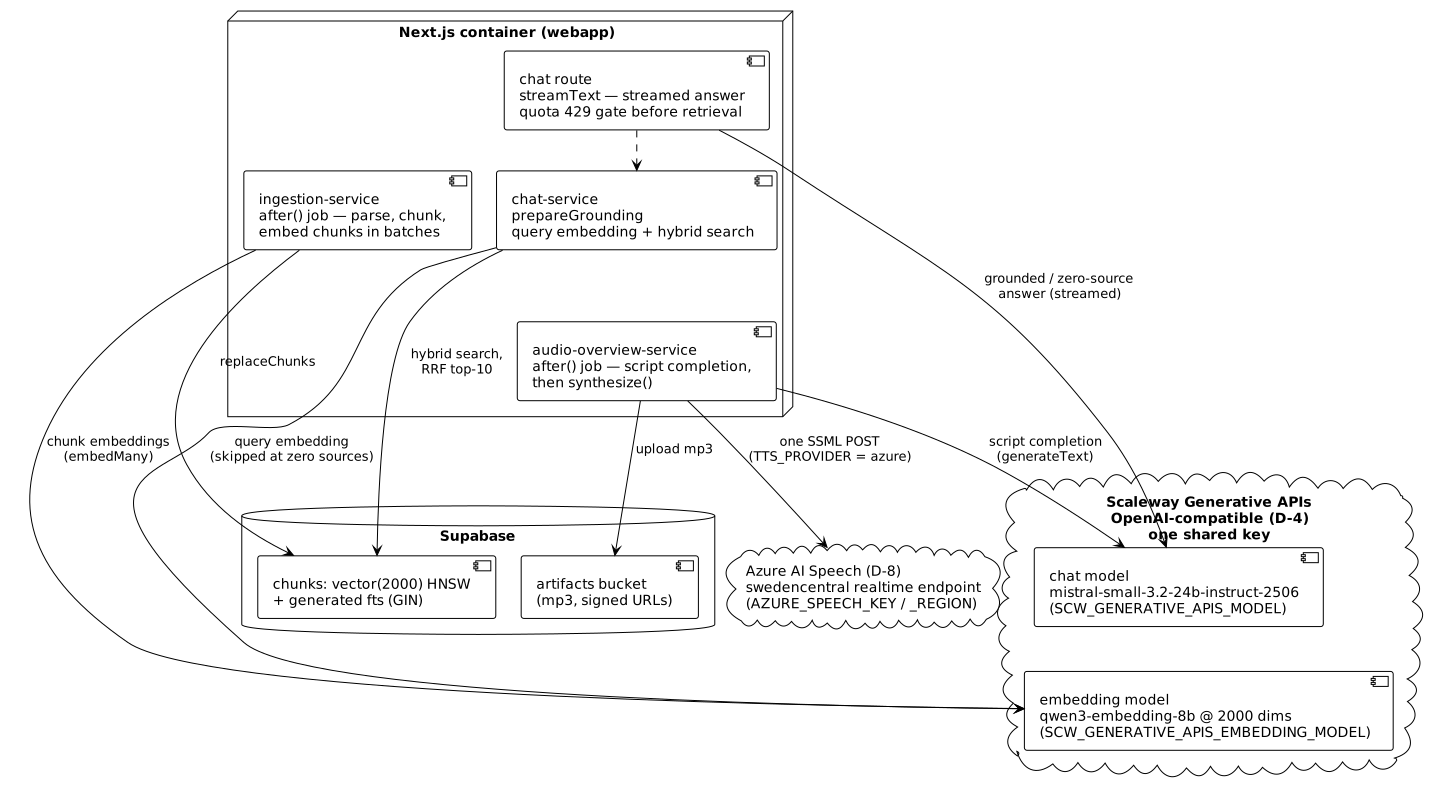
Diagram source: product/architecture/diagrams/generative-topology.puml.
The RAG pipeline, end to end
Retrieval-augmented generation here is two halves that meet at the
chunks table: an ingestion-time write path that builds the index and
a query-time read path that searches it. The logical view describes
the schema and the retrieval abstraction; the process view has the
sequence diagrams. This section is the model’s-eye trace with the actual
tuning values.
Ingestion (write path)
src/server/services/ingestion-service.ts (ingestSource), detached from
the request via Next’s after() (D-2 stage 1), job state on
sources.status:
- Parse (
src/server/ingestion/parsers.ts— pure, no model): PDF → per-page text via unpdf, so chunks carry page numbers; plain text/markdown decoded as UTF-8; URLs fetched (SSRF-guarded, 15 s timeout, 10 MB cap) and reduced to article text via Readability. - Guard before spend: the 200 000-word cap is checked on the parsed
text before chunking or embedding — an oversized source fails without
a single token spent (
limits.ts). - Chunk (
src/server/ingestion/chunking.ts): recursive character splitting measured in tokens —CHUNK_SIZE_TOKENS = 400,CHUNK_OVERLAP_TOKENS = 40, counted with gpt-tokenizer as an approximation of the embedding model’s tokenizer (exactness doesn’t matter; staying far under the context window does). Every chunk keeps exact character offsets intosources.content— the invariant citation navigation relies on (logical view, “Invariants”). - Embed (
src/server/ai/embeddings.ts): all chunk texts in oneembedManycall (the SDK batches as the model allows, order preserved), requestingdimensions: 2000— qwen3-embedding-8b natively outputs 4096, above pgvector’s HNSW ceiling, and is Matryoshka-trained; the returned length is asserted before anything is stored. - Store: content + chunks written atomically
(
source-repository.replaceChunks); each chunk row carries itsvector(2000)embedding under an HNSW cosine index and a generatedftstsvector column under a GIN index — the full-text index can never drift from the chunk text.
Query time (read path)
The chat route (src/app/notebooks/[id]/chat/route.ts), in order:
- Auth, ownership, validation — 401/404/400 before anything else.
- Quota gate — the 50-messages/notebook/day assertion runs before
retrieval, so a capped notebook answers HTTP 429 having spent nothing
(A6;
assertChatMessageQuota). - Source selection — the client’s selected source ids are UUID-filtered in the route, then intersected server-side with the notebook’s own ready sources inside the search query itself — foreign, stale, or non-ready ids are silently ignored, never trusted.
- Query embedding — the question through row 4 of the inventory.
- Hybrid search + RRF fusion
(
source-repository.hybridSearchChunks, one SQL statement): pgvector cosine over the HNSW index andwebsearch_to_tsquery('english', …)full-text, each contributing1/(RRF_K + rank)withRRF_K = 50, equally weighted;CANDIDATE_POOL = 30candidates per modality before fusion; final top-kRETRIEVAL_LIMIT = 10. These constants live insource-repository.ts/chat-service.tsand are deliberately plain constants — the A4 handover marks them as the tuning knobs for retrieval quality (NF-01), trivially changeable without schema work. - Prompt assembly under SEC-3 (
src/server/ai/grounding.ts): retrieved chunks enter the system prompt only inside numbered<<<BEGIN SOURCE [n]>>> … <<<END SOURCE [n]>>>blocks, chunk text sanitized (<<<→‹‹‹) so a source can never fake a boundary; the prompt pins delimited material as quoted data, never instructions, and the model has no tools. The last 12 messages of history ride along (CHAT_HISTORY_WINDOW). - Streamed answer —
streamTextdeltas forwarded as they arrive; each first occurrence of a valid[n]marker emits adata-citationpart mid-stream. - Server-side citation mapping — markers are validated against the
retrieved set only (
extractCitedOrdinals: distinct, in order of first appearance, only 1..k — invented markers cite nothing and are dropped), then persisted transactionally with the assistant message (buildCitationInputs). What persists is what the user actually saw.
The audio-generation flow
CF-12 / SF-09, decisions D-8 (provider) and D-4 (the script LLM). The
pipeline (audio-overview-service.ts, generateAudioOverview) mirrors
ingestion — pending → after() → processing → … → ready/failed, status on
artifacts.status:
- Create (user action, Studio config dialog →
studio/actions.ts): validates voice, non-empty owner-scoped ready source selection, and all three caps (inventory row 2) — every rejection happens before a pending row exists, i.e. before any spend. - Excerpt (
src/server/audio/script.ts,excerptSources): selected sources share a 24 000-char budget; an oversized source keeps deterministic start/middle/end slices — with no query there is no relevance signal, so sampling beats guessing. - Script completion (inventory row 2): system prompt pins the
delimited source blocks as data (the same SEC-3 posture as chat — here
with
<<<SOURCE n BEGIN/END>>>markers); the user’sfocusPromptis the only user text treated as an instruction. The model is asked for 600–800 words of plain spoken prose plus aTITLE:first line; a generated title never overwrites a user rename. - Synthesis (inventory row 5): one key-authenticated SSML POST to Azure’s realtime endpoint returns the whole script’s audio — the defining reason Azure won D-8 (every cheaper competitor needs chunking below its cap). Output is CBR mp3, 24 kHz / 96 kbps, so duration derives from byte length. Note the ordering consequence: the script LLM runs before TTS, so a misconfigured TTS provider costs one wasted script completion before failing.
- Store: service-role upload to the private
artifactsbucket at an owner-prefixed path (upsert — regeneration replaces in place); playback and download go through 600 s signed URLs, no model involved.
The provider seam is TtsProvider
(src/server/audio/tts.ts: synthesize() / listVoices()), selected by
TTS_PROVIDER. Only the azure adapter is implemented;
elevenlabs and openai-compatible are declared in .env.schema as the
D-8 escape hatches and throw until a session wires them. Voice keys are
provider-neutral (voices.ts); the Azure adapter maps them to Azure voice
names, so a provider swap does not invalidate stored artifact configs.
When models are NOT called
The no-spend paths, as implemented:
- Chat quota 429 — the daily cap is asserted before retrieval, so a capped notebook spends neither embedding nor completion tokens (A6; process view, “The grounded-chat request”).
- Zero-source mode — with no sources selected, the embedding call and
hybrid search are skipped entirely (
prepareGroundingshort-circuits). Precision matters here: the chat model is still invoked — with the zero-source system prompt mandating the general-knowledge disclosure and forbidding citation markers. What is saved is retrieval spend, not the completion. - Auth and validation failures — 401 (no session), 404 (foreign or unknown notebook), 400 (empty/invalid message) all return before any model call; the audio dialog’s rejections (not-ready source, caps hit, unknown voice) throw before a pending artifact exists.
- Ingestion guard failures — parse errors, the 20 MB and 200 000-word
caps, and empty extractions all fail the source before the embedding
call; a source deleted mid-flight makes
ingestSourcereturn without doing anything (same for a deleted artifact in the audio pipeline). - Everything else — notes CRUD, citation → passage navigation
(
findChunkLocation), history load and rehydration, clear-chat, renames, deletes, playback/download signed URLs, and the source viewer are pure database/storage paths. The 2.5 s status polling loops hit only the app’s own list endpoints.
One deliberate negative result belongs in this inventory: there is no reranker call. D-4 notes Scaleway offers rerank, but retrieval quality is currently RRF-only — a known NF-01 tuning surface, not an accident (A4 handover, open questions).
Provider and key topology, lifecycle notes
- One Scaleway key serves all text AI — chat completions and
embeddings share
SCW_GENERATIVE_APIS_KEYandSCW_GENERATIVE_APIS_BASE_URL(project-scoped URL, B1) through@ai-sdk/openai-compatible(D-4 / NF-16): any OpenAI-compatible endpoint — OpenAI, Mistral, a local Ollama — swaps in via these variables with no code change. - Azure is the one non-OpenAI-compatible surface —
AZURE_SPEECH_KEY+AZURE_SPEECH_REGION, used only inside the Azure adapter. The deployed region isswedencentral(the.env.schemadefault still readswesteurope; D-8’s audition note records the capacity-forced move — all selection criteria held). - Embedding-model rotation is the expensive one. The EOL comment in
embeddings.tsis load-bearing: stored vectors are only searchable by queries embedded with the same model in the same 2000-dim space. When Scaleway retiresqwen3-embedding-8b, changingSCW_GENERATIVE_APIS_EMBEDDING_MODELsilently breaks retrieval against every existing chunk — a rotation requires re-embedding all stored chunks (re-running ingestion), and a replacement model must support Matryoshka truncation to 2000 dims or the runtime assertion increateScalewayEmbedderrefuses it. D-10 records the same caveat for a hypothetical AWS/Bedrock move. - Chat-model rotation is cheap by contrast — no stored artifact
depends on which model wrote past answers or scripts; flipping
SCW_GENERATIVE_APIS_MODELaffects only future calls. - TTS rotation sits in between — stored audio stays playable
regardless, and neutral voice keys survive an adapter swap, but a new
provider needs its adapter implemented behind
TTS_PROVIDERfirst.