Rendered from the repository — the file stays the source of truth.
Physical view — deployment topology
Status: Snapshot as of 2026-08-18 (session C5). Describes
infrastructure/*.tf,apps/webapp/Dockerfile, and the deploy workflows as merged (PR #11 B1, PR #13 B2, PR #19). Not yet real: hosted Supabase (B3 pending — the webapp’s data plane runs against the local Supabase stack today) and Azure Speech (D-8 decided, wiring is D2’s in-flight work).Update (2026-08-18, session B3): both of the above are now real — see Hosted Supabase (B3) at the end of this document.
Extended 2026-08-18 (session C6): “Platform choice” section added, referencing decision D-10.
Update (2026-08-18, session C8): the hosted Supabase project is now Terraform-managed (session B5, PR #48) — see the updated Terraform section and the note under Hosted Supabase (B3).
Platform choice
The target company works with AWS; running on Scaleway is a deliberate,
owner-decided deviation — more cost-effective, less organisational
overhead, and every building block on this page is deliberately
interchangeable (the same Docker image, S3-compatible storage driven by
aws s3 sync, an s3 Terraform backend, the D-4 provider abstraction).
The decision, a per-building-block AWS interchange map verified against
the code and workflows, and its honest caveats are recorded as D-10
in product/feasibility.md.
Topology
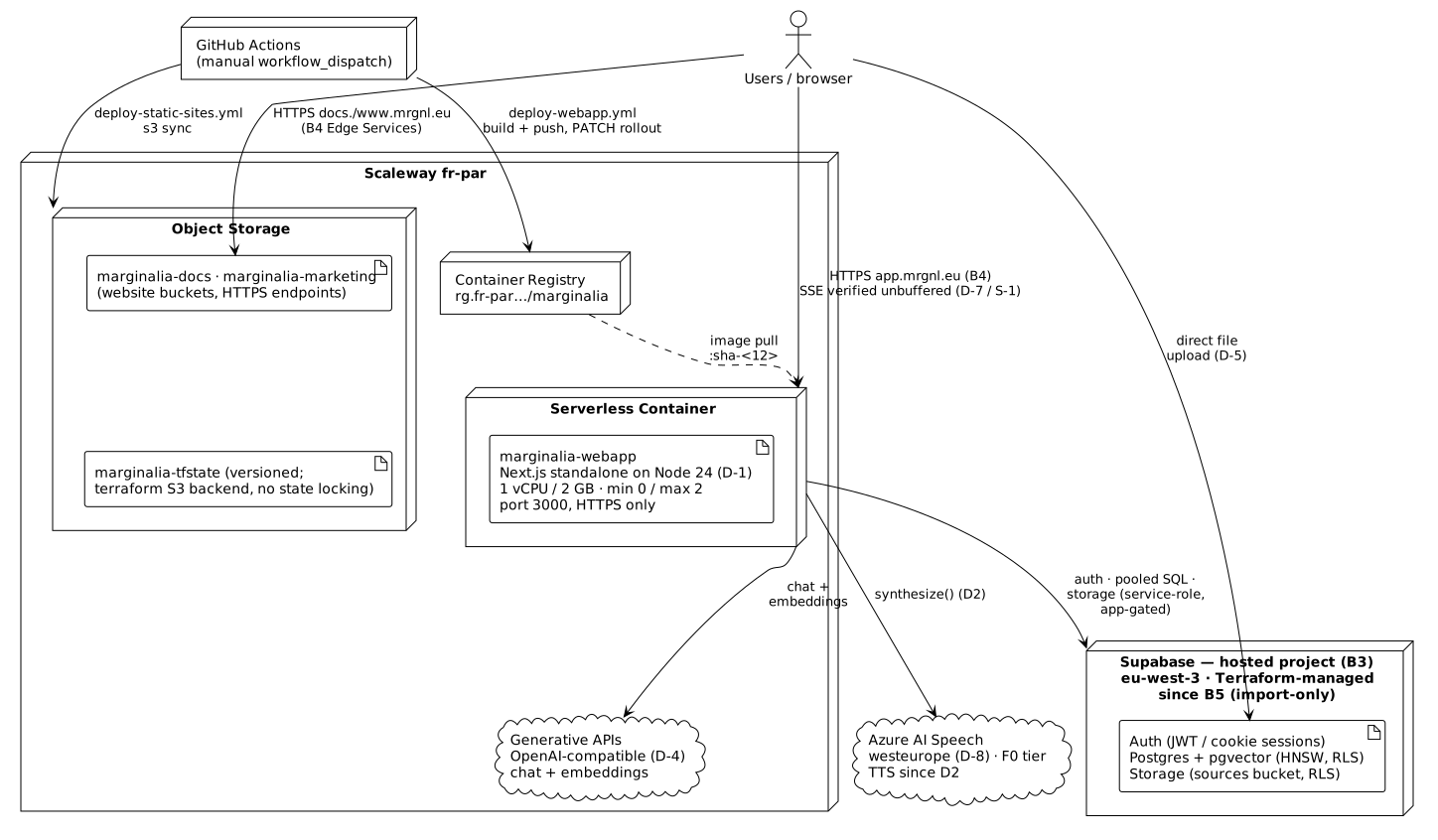
Diagram source: product/architecture/diagrams/physical-topology.puml.
Key verified properties:
- Node, not Bun, runs production (D-1): the Dockerfile
(
apps/webapp/Dockerfile) uses Bun only to install dependencies (hoisted linker — Bun 1.3’s isolated store breaks Next’s standalone file tracing);next buildand the runtime are Node 24, officialoutput: "standalone"pattern. - SSE streams through the serverless gateway unbuffered and
untruncated — spike S-1 measured it against a real deployment (D-7,
product/feasibility.md); cold start from zero: 3.89 s TTFB, warm ~0.1 s. The container runsmin_scale = 0today; demo mode raises it (B3). - Uploads bypass the container (D-5): browser → Supabase Storage
directly, under
<userId>/…paths guarded by storage RLS; the app only ever receives the object path.
Terraform
infrastructure/ (provider scaleway/scaleway) manages: the tfstate
bucket (versioned; a bootstrap chicken-and-egg documented in main.tf —
it stores the state that tracks it), the two website buckets, the registry
namespace, the container namespace, and the scaleway_container webapp
resource. State lives on the Scaleway S3-compatible backend (B2); the
backend reads AWS-named credentials, and there is no state locking —
one person/pipeline applies at a time (infrastructure/AGENTS.md).
(Updated 2026-08-18, session C8, for B4 and B5.) Since B4
(PR #45), the same
configuration also manages the mrgnl.eu DNS zone and records, the Edge
Services pipelines, and the apex-redirect function (domain.tf — see
Custom domain (B4) below). Since B5
(PR #48), a second
provider, supabase/supabase, manages the hosted Supabase project by
import only: supabase_project.marginalia in supabase.tf carries
prevent_destroy = true and a permanent import block, and the adoption
gate was a terraform plan -detailed-exitcode exit-0 — a plan that
proposes replace/destroy on the project is a config bug, never something
to apply (infrastructure/AGENTS.md). The container’s Supabase env values
come from the supabase_apikeys data source instead of hand-copied
variables. Terraform owns only the project’s lifecycle; migrations,
storage policies, and all config.toml-modeled settings stay with the
Supabase CLI — the ownership split is documented in supabase/AGENTS.md.
Two state/credential nuances (SEC-6, product/security.md): the hosted
database password is not in Terraform state (unreadable at import;
ignore_changes = [database_password]), while the anon and service-role
keys read by the data source are — the same accepted class as the
container’s secret_environment_variables. Every plan/apply now requires
SUPABASE_ACCESS_TOKEN, which is keyring-only and injected per command
(wrapper in infrastructure/AGENTS.md), never stored in .env.local,
state, or the vault.
Deploy workflows (both manual workflow_dispatch for the prototype)
deploy-webapp.yml — builds the Docker image, pushes an immutable
:sha-<12> tag plus a moving :latest, then PATCHes the container’s
image via the Containers API. Rollout semantics learned the hard way
(PR #19): an
image-changing PATCH starts the rollout itself; /redeploy is only for
no-op PATCHes and 4xxs during a rollout. Waits for ready, then smoke
tests — expecting HTTP 307, because anonymous requests must redirect
to /login (the auth proxy is part of the deploy contract).
deploy-static-sites.yml — builds apps/docs and apps/marketing,
aws s3 sync --delete --acl public-read to the website buckets. Sites are
served from the default bucket-website endpoints (HTTPS included); Edge
Services / custom domains are B3.
Update (2026-08-18, session B4): custom domains are live — see Custom domain (B4) below. Bucket-website default endpoints remain serving as fallbacks.
Secrets flow
Declared once, resolved per environment; values never committed
(SEC-6, product/security.md):
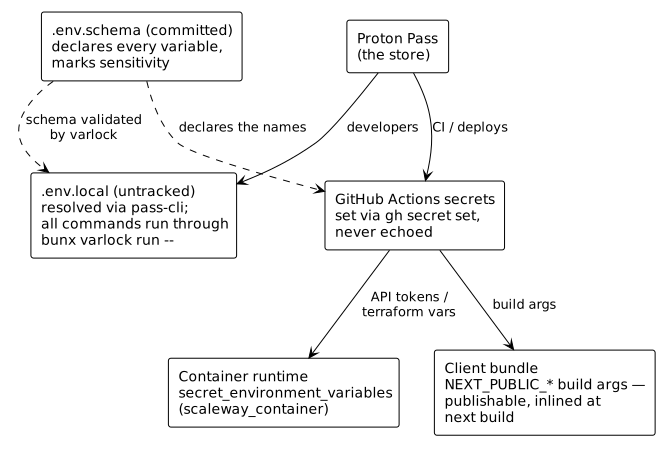
Diagram source: product/architecture/diagrams/physical-secrets-flow.puml.
When B3 points the container at a hosted Supabase project, its server keys
join the container’s secret environment variables.
The schema also already declares the D2 surface (TTS_PROVIDER,
AZURE_SPEECH_KEY, AZURE_SPEECH_REGION — D-8), ahead of the in-flight
wiring.
Hosted Supabase (B3, 2026-08-18)
The webapp’s data plane is hosted since session B3: Supabase project
marginalia (ref ahphkkvsofqmxkqzbica, eu-west-3 / Paris — colocated
with the fr-par container; Free tier, owner decision — the idle-pause
trade-off is recorded in product/feasibility.md). The full
supabase/migrations timeline is applied (8 tables + RLS, HNSW + FTS
indexes, sources/artifacts buckets; pgvector 0.8.2, identical to local).
Hosted auth config is code: the [remotes.demo] section of
supabase/config.toml, pushed with supabase config push (email+password
signup on, email confirmation off for the demo, site URL = the container
endpoint). The container now receives NEXT_PUBLIC_SUPABASE_URL/ANON_KEY,
AZURE_SPEECH_REGION, TTS_PROVIDER as plain env and
SUPABASE_SERVICE_ROLE_KEY, DATABASE_URL (transaction pooler, port 6543,
prepare: false), AZURE_SPEECH_KEY, SCW_GENERATIVE_APIS_KEY as secret
env, all via Terraform; min_scale is the webapp_min_scale tfvar
(0 idle / 1 for demo windows).
Update (2026-08-18, session C8): since B5 (PR #48) the project itself is a Terraform resource (import-only — see the Terraform section above), and the container’s
NEXT_PUBLIC_SUPABASE_URL, anon key, and service-role key are fed from thesupabase_apikeysdata source rather thanTF_VARs; the legacyTF_VAR_supabase_*declarations are annotated as prunable in.env.schema(still read byseed:demo’s hosted mode — foreman-2 handover). The Free tier’s no-backups trade-off now has a recorded recovery procedure: recreate the project (migrations and config are all code), then run A6’s idempotentbun run seed:demo(PR #49).
Custom domain (B4, 2026-08-18)
The product lives on mrgnl.eu (registered through Scaleway Domains; the
root zone is native to the account, records in infrastructure/domain.tf):
- app.mrgnl.eu → webapp container, via the native container custom domain (CNAME + platform-issued Let’s Encrypt cert, HTTP-01) — no Edge Services pipeline needed.
- docs.mrgnl.eu / www.mrgnl.eu → Edge Services pipelines (Starter plan, €0.99 + €4/mo for the second pipeline) with bucket-website backends and managed Let’s Encrypt certificates. The docs/www CNAMEs are the one exception to DNS-in-Terraform: Edge Services creates and owns them (verified at apply).
- mrgnl.eu (apex) → 301 to
https://www.mrgnl.euvia a minimal serverless function bound to the apex (ALIAS + auto-issued cert), because Edge Services is subdomain-only (verified against its docs, 2026-08-18). - Supabase auth
site_urlishttps://app.mrgnl.eu; the original container endpoint stays on the redirect allow-list, and all previous default endpoints keep serving.