Rendered from the repository — the file stays the source of truth.
Logical view — the domain model as implemented
Status: Snapshot as of 2026-08-18 (session C5). Describes
apps/webapp/src/server/db/schema.tsand the repository layer as merged (PR #6 A1, PR #15 A3, PR #24 A4). Sessions A5 (notes UI, citation navigation) and D2 (audio artifacts) are in flight and will extend this model’s usage, not its shape.Correction (2026-08-18, session C8): both merged the same day — and D2 (PR #27) did extend the shape: the artifacts table plus
artifact_type/artifact_statusenums now exist (generic artifact foundation, scope §3;audio_overviewthe only type so far, a replayableconfigjsonb, owner-chain RLS, and a privateartifactsstorage bucket). A5 (PR #29) put the notes table and citation offsets to work without schema changes, and A6’s quotas (PR #49) are repository count queries — also no schema change. “Not yet in the schema” below now reads: permissions only. Details inproduct/history/webapp.md.
The notebook aggregate
Everything hangs off the notebook, which belongs to exactly one owner. The
implemented model is the Phase 1 subset of the ideal in product/scope.md
§10:
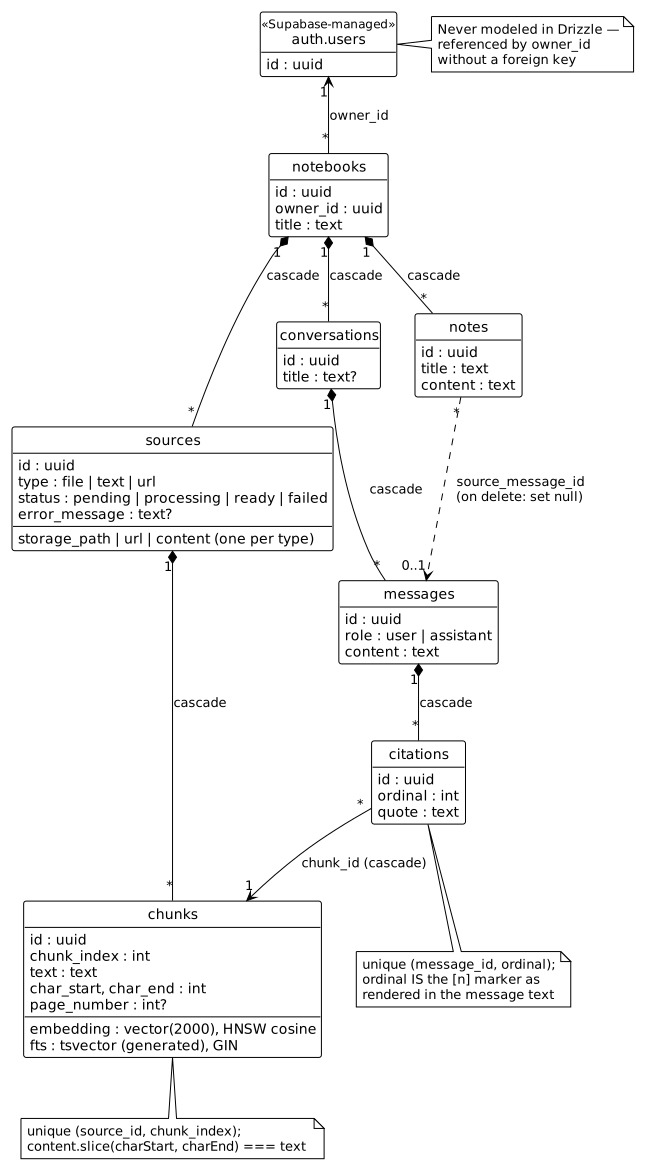
Diagram source: product/architecture/diagrams/logical-domain-model.puml.
All child tables cascade on notebook deletion (CF-01 “delete notebook
removes associated data”). Deleting a source cascades through its chunks to
the citations pointing at them — a documented Phase 1 simplification: the
[n] marker in the stored message text simply stops resolving
(schema.ts, comment on citations.chunkId).
Not yet in the schema, relative to scope §10: artifacts (D2 is building
the first one, audio) and permissions (sharing is SF-05, post-MVP).
The notes table and its repository
(apps/webapp/src/server/repositories/note-repository.ts, full owner-scoped
CRUD) exist since A1, but no UI or server action uses them yet — that is
A5’s work, running now.
Invariants the schema enforces
chunks (source_id, chunk_index)unique — a source’s chunk sequence has no duplicates; ingestion replaces the whole set atomically (source-repository.replaceChunks).citations (message_id, ordinal)unique — the stored ordinal is the marker number rendered in the message text ([1],[2], …), deliberately not renumbered to be consecutive, so citation chips always match the streamed text (apps/webapp/src/server/ai/grounding.ts,buildCitationInputs).chunks.ftsis a generated column (to_tsvector('english', text)) — the full-text index can never drift from the chunk text.- Chunk offsets satisfy
content.slice(charStart, charEnd) === textagainstsources.content— the raw material for citation navigation (A5). Enforced inapps/webapp/src/server/ingestion/chunking.ts, verified for 90/90 chunks in A3’s end-to-end run (handovers/2026-08-18-session-a3-ingestion.md).
Embeddings: vector(2000)
chunks.embedding is vector(2000) under an HNSW cosine index. The
embedding model (qwen3-embedding-8b, feasibility D-4) natively outputs
4096 dimensions — above pgvector’s 2000-dim HNSW ceiling — and is
Matryoshka-trained, so embeddings are requested at 2000 dimensions and the
returned length is asserted before insert (EMBEDDING_DIMENSIONS in
schema.ts; apps/webapp/src/server/ai/embeddings.ts). The story behind
this choice is in product/history/webapp.md.
Ownership and isolation
Notebook isolation (CF-01) is owner-scoping, enforced twice:
- App layer — the primary guard. The authenticated user id (
auth.uid()from the verified JWT —getClaims(), nevergetSession();apps/webapp/src/server/auth.ts) is theownerIdthat every repository method takes and applies. Root queries filternotebooks.owner_id; child-table writes use a correlatedexists(… notebooks.owner_id = ownerId)subquery (ownedByCallerin each repository) so even single-statement UPDATE/DELETEs stay scoped. Cross-user access surfaces as not-found, tested in each*-repository.test.ts. - RLS — defense-in-depth, not the primary guard (SEC-5,
product/security.md). The app connects through the pooler aspostgres, which RLS does not bind, and the storage client uses the service-role key. The policies (supabase/migrations/20260817170000_rls_policies.sql: all 7 tables, keyed onnotebooks.owner_id = auth.uid()through each FK chain, plus storage objects keyed on the path’s first segment) protect any future PostgREST/Realtime path with user JWTs. If such a path is ever added, RLS becomes load-bearing and gets re-audited — that trigger is recorded in SEC-5.
The retrieval abstraction
Retrieval is one repository method,
source-repository.hybridSearchChunks — a single SQL statement combining:
- Vector search: pgvector cosine (
<=>) over the HNSW index. - Full-text search:
websearch_to_tsquery('english', …)against the generatedftscolumn (GIN index). - Fusion: reciprocal rank fusion,
1/(50 + rank)per modality, equally weighted (Supabase’s documented pattern, feasibility F-3); candidate pool 30 per modality, final top-k 10 (constants insource-repository.ts).
Scoping is part of the query, not an afterthought: the allowed_sources
CTE joins sources→notebooks on owner_id and notebook_id and
status = 'ready', then intersects with the caller-selected source ids —
foreign, stale, or non-ready ids are silently ignored, never trusted
(CF-05; tested including foreign-id injection in
hybrid-search.test.ts).
It is implemented as a Drizzle sql template rather than a database
function, so the exact production query runs in the tests and the logic
stays visible in the repository layer — the DDD trace stays intact (A4
decision, handovers/2026-08-18-session-a4-grounded-chat.md).
The full RAG pipeline this query sits in — which models embed and answer, triggered by what, bounded by which quotas — is traced end to end in the generative view (added 2026-08-18, session C9).
The grounding contract (SEC-3)
Source content is untrusted input (NF-17). The contract, implemented in
apps/webapp/src/server/ai/grounding.ts and recorded as SEC-3 in
product/security.md:
- Retrieved chunks enter the prompt only inside delimited
<<<BEGIN SOURCE [n]>>> … <<<END SOURCE [n]>>>blocks; chunk text is sanitized (<<<→‹‹‹) so a source can never fake a block boundary. - The system prompt declares the quoted material to be data, never instructions; the chat model has no tools and no authority beyond emitting answer text.
[n]markers in the answer are mapped server-side against the retrieved set only — invented markers (out of range 1..k) cite nothing and are dropped (extractCitedOrdinals).- With zero sources selected, retrieval is skipped entirely and a separate
system prompt mandates the general-knowledge disclosure and forbids
citation markers (
buildZeroSourceSystemPrompt).
Residual risk (a hostile source biasing answers about itself) is accepted while sources are user-chosen; the re-review triggers (chat gains tools, or shared notebooks) are recorded in SEC-3.